How to Automate Customer Follow-Ups With AI (Without Losing the Human Touch)
6 min read
The follow-up gap every small business knows too well
You meet someone interested in your service. You sell a great product. A customer books an appointment. Then... life happens. The thank-you note never goes out. The reminder slips. The lead who was this close goes quiet because nobody followed up in time.
It's not that you don't care. It's that follow-up is repetitive, easy to forget, and almost always loses to whatever's on fire today.
That's exactly why follow-ups are one of the best places to bring in AI. They happen the same way every week, and they directly support revenue, retention, and your time. If a task checks those boxes, it's a strong candidate for automation. Follow-up checks all three.
This isn't experimental anymore
If automating customer messages feels like a big leap, here's some reassurance: plenty of small businesses are already doing it.
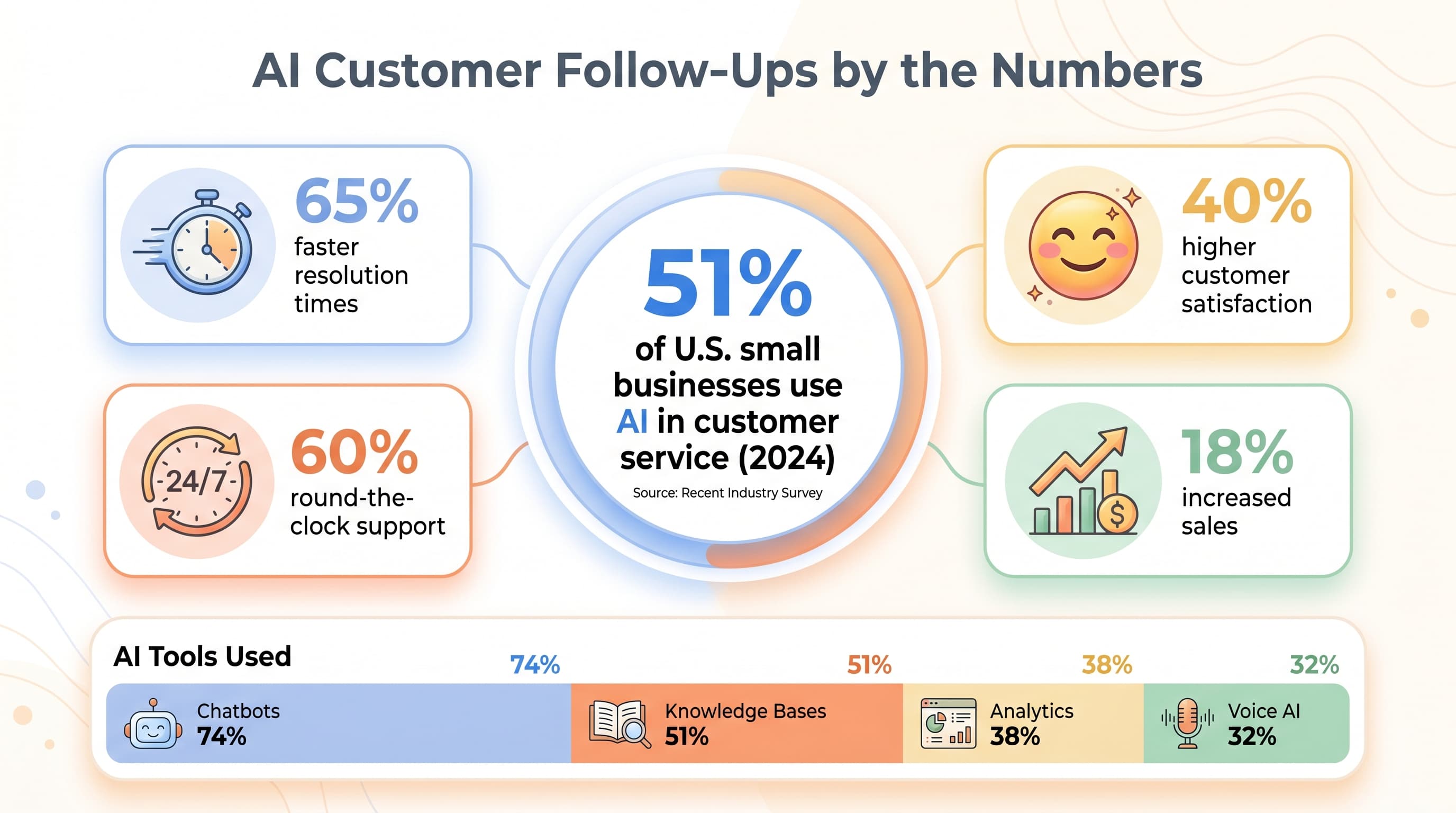
A 2024 Talkdesk survey found that 51% of U.S. small businesses have integrated AI into their customer service operations. Among those using it, 74% rely on AI-powered chatbots and 51% use AI-driven knowledge bases to respond faster.
And the results are practical, not flashy:
- 65% reported faster resolution times
- 60% gained round-the-clock support
- 40% saw higher customer satisfaction
- Nearly 18% linked AI to increased sales
Notice the theme. Faster responses, 24/7 availability, happier customers — these all come down to consistent, timely communication. Which is the whole job of a good follow-up.
Six follow-ups worth automating first
You don't need to automate everything. Pick one or two of these to start.
1. Lead follow-up and nurturing. When a new form submission or DM comes in, AI can send an instant, professional reply — thank them, share key info, suggest a next step like booking a call. Then a 7–14 day sequence drips out FAQs, testimonials, and offers, flagging the warm leads for you to call personally. For a solo founder who can't reply to every inquiry at midnight, this alone is a game-changer.
2. Post-purchase check-ins. A simple "How's your order? Any questions?" a few days after a sale keeps customers happy and opens the door to reviews and referrals. AI can also identify repeat buyers and automatically offer them early access or a loyalty perk.
3. Cart-abandonment and browse reminders. AI chatbots can nudge someone who left items in their cart, or recommend products based on what they've bought before. This is what big retailers do with full marketing teams — and now a micro-brand can do it too.
4. Appointment reminders. Service businesses can connect their booking system to a chatbot that confirms appointments, sends an SMS reminder 24–48 hours ahead, and follows up afterward asking for feedback or prompting a rebooking. Fewer no-shows, more repeat visits.
5. Support and FAQ follow-ups. Chatbots can answer the same questions you answer every day — store hours, return policy, pricing, order tracking — and pull live shipping info so customers get instant updates. Your team stays free for the complex stuff.
6. Payment reminders. Connected to your invoicing software, AI can send polite, branded reminders as a due date approaches, then flag overdue accounts for you. No more awkward "just checking in on that invoice" emails.
How smart small businesses actually roll this out
The owners getting real value from AI follow-ups tend to follow a few simple habits.
They keep a human in the loop at first. A good progression: AI drafts the copy, you approve what matches your brand, and only the proven flows get fully automated. This isn't just caution — it's common practice. In that same survey, 43% of small businesses said they prioritize human oversight of AI interactions, and 41% set clear guardrails for what AI can and can't do on its own.
They start with one workflow and one metric. Don't try to automate your whole business at once. Pick a single follow-up tied to growth — say, re-engaging customers who haven't bought in 60 days. Define a clear trigger (no purchase in 60 days) and a clear outcome (a return purchase). Then track one number: repeat purchase rate. When it's working, move to the next workflow.
They go multi-channel. Good follow-up isn't just email anymore. The same automated flow might reach someone by email, then SMS, then a chat message — meeting customers where they actually pay attention, without you lifting a finger for each touch.
They connect their tools. Automation works best when your CRM, email, payments, and booking systems talk to each other. When data flows automatically, follow-ups trigger on their own and nothing slips through the cracks.
What 'done right' looks like in real businesses
A few quick pictures to make this concrete:
A local boutique sends a thank-you text after each purchase, a styling-tips email with related products three days later, and a re-engagement offer if a customer hasn't returned in 60 days. They watch repeat purchase rate and revenue per customer.
A salon connects its booking system to a chatbot that handles scheduling, sends a reminder 24 hours before each appointment, then follows up with a review request and a discount on the next visit. They track no-show rate, reviews, and rebookings.
A freelancer uses a website chatbot to collect project details, then an automatic email series that shares case studies and invites the prospect to book a call. They measure booked calls per lead.
An e-commerce micro-brand runs a 24/7 chatbot for pre-sale questions and triggers cart-abandonment messages with product tips and a limited-time offer. They track cart recovery and average order value.
None of these required hiring a marketing team. They just required automating the follow-ups that were already supposed to happen — and making them happen every single time.
Keeping it human (and trustworthy)
Automation done badly feels robotic and pushy. Done well, it feels like a business that's simply on top of things.
A few guardrails keep you on the right side of that line:
- Start with low-risk tasks — FAQs, order updates, standard check-ins, payment reminders. Save anything sensitive for a human.
- Approve messages before going fully autonomous. Read what the AI sends until you trust the tone.
- Be transparent. Roughly a third of small businesses disclose when AI is involved — it sets expectations and builds trust.
- Review regularly. Glance at your automated messages now and then to catch anything off-brand, and refine your templates and targeting.
- Measure what matters. Time saved per week, revenue from a campaign, fewer missed appointments — pick the number that proves it's working.
Follow-up is the kind of work that quietly decides whether a customer comes back or drifts away. AI doesn't replace the warmth you bring to your business — it just makes sure the message actually goes out, on time, every time, so you can spend your hours on the work only you can do.