How AI Cuts Your Business Costs Over the Long Run
6 min read
The real cost story behind AI
When people hear "AI in business," they often picture something complicated and expensive — or worse, the idea that a machine is going to replace what they do.
That's the wrong way to think about it. For most small businesses, the strongest case for AI isn't replacement. It's that you can do the same work with fewer hours, fewer mistakes, and more targeted spending.
The U.S. Small Business Administration puts it simply: AI helps small businesses "do more with less" — saving time and money while staying competitive during inflation and labor shortages.
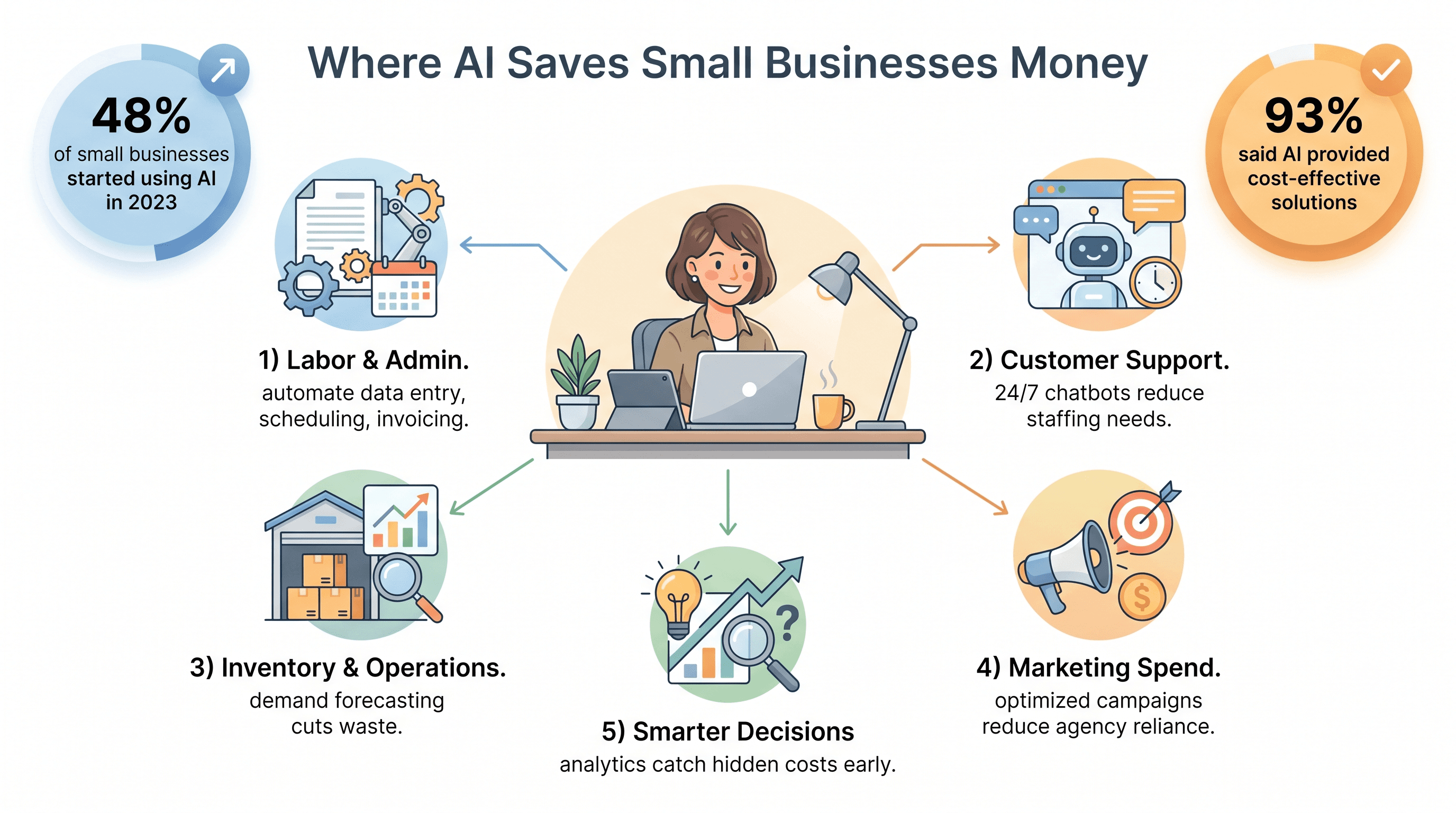
And owners are noticing. According to figures from the Small Business and Entrepreneurship Council cited by Coursera, 48% of small businesses started using AI tools in 2023. Of those, 93% said AI provided cost-effective solutions that improved profitability.
That's not a fringe experiment anymore. That's nearly half of small businesses finding that AI pays for itself.
Two kinds of savings: direct and compound
It helps to think about AI savings in two buckets.
Direct savings are the obvious ones. Fewer hours spent on repetitive tasks. Less money spent on admin, support coverage, and broad marketing campaigns that don't perform.
Compound savings are quieter but often bigger over time. These come from better forecasting, fewer errors, and faster decisions — the things that stop small inefficiencies from snowballing into expensive problems.
Microsoft and the British Business Bank both frame AI the same way: a tool to reduce operational costs by automating repetitive work, improving productivity, and lowering labor and IT expenses.
The point is that AI doesn't just save you money once. It keeps saving you money as your business runs.
Where the labor savings actually come from
Most of your week probably includes tasks that don't really require your judgment. They just require someone to do them.
AI is good at exactly that kind of work:
- Data entry and invoicing
- Sorting your inbox and flagging what matters
- Scheduling meetings and appointments
- Taking and summarizing meeting notes
- Answering common customer questions
When those tasks get handled automatically, your team spends less time on routine work and more time on the things that actually grow the business.
For a professional services firm, that might mean AI drafting routine documents, summarizing meetings, and managing scheduling — so staff can focus on billable work instead of admin.
The hours add up. One source cited in discussions of AI and small business suggests AI-powered automation can increase productivity by up to 40%. Treat that number as a ceiling rather than a promise, but the direction is clear: less time on busywork means lower labor costs for the same output.
Cutting support costs without cutting service
Customer support is one of the easiest places to overspend — or to lose customers because you can't respond fast enough.
AI-powered chatbots can answer common questions 24/7, which reduces the need for a larger support team or extended coverage hours.
Picture a local service business. Customers often have the same handful of questions: your hours, your pricing, whether you're available next week. A chatbot can handle those after hours, so you're not paying for late-night staffing or losing leads who wanted an answer at 9 p.m.
And this isn't a trade-off between cost and quality. Research from Aberdeen, cited by the British Business Bank, found that companies using AI capabilities achieved a 3.5 times greater annual increase in customer satisfaction rates. Faster answers tend to make customers happier, not unhappier.
Less waste in inventory and operations
If you carry stock, you already know the two ways inventory costs you money: you hold too much, or you run out.
AI can forecast demand and optimize inventory, which helps cut both overstocking and stockouts. That directly reduces carrying costs and the lost sales that come from empty shelves.
For a retail or ecommerce business, an AI tool can restock automatically, predict what will sell, and even generate product descriptions and promotions — trimming both stock errors and marketing labor at the same time.
One secondary figure, drawn from a McKinsey Global Institute report and cited in discussions of AI in small business, suggests AI can reduce inventory-management costs by up to 70%. That's a striking number worth taking with a grain of salt, but the underlying logic is sound: better forecasting means less money tied up in the wrong stock.
The same idea applies beyond inventory. Predictive tools can flag logistics or maintenance issues before they become expensive — one cited example points to a 30% reduction in downtime through predictive maintenance.
Fewer errors, smarter spending, better decisions
Mistakes are expensive, and most of them happen in routine work — a wrong number on an invoice, a missed follow-up, a scheduling mix-up. Automating that routine work minimizes human error in admin, communications, and operations, which lowers the cost of fixing things later.
Marketing is another place where small businesses leak money. AI can personalize content, optimize ad campaigns, and generate social posts or product descriptions. For a marketing-heavy business, that can mean less reliance on outside agencies and less spend on broad, low-performing campaigns.
Finally, there's decision-making. AI analytics can surface inefficiencies, hidden costs, and financial risks earlier — so you can avoid expensive mistakes instead of discovering them in next quarter's numbers. As Investopedia summarizes it, the core benefits for small businesses come down to increased efficiency, cost savings, better customer service, and growth opportunities.
Why now is a good time to start
A few trends make this the right moment to look seriously at AI.
First, adoption has moved from experiment to routine. With nearly half of small businesses already using AI tools in 2023, this is becoming a normal part of running a business — not a gamble.
Second, the barrier to entry has dropped. The SBA notes that many AI tools offer basic services for free or at a lower cost, which makes adoption realistic even on a tight budget.
Third, generative AI has broadened what's possible. Small businesses now use AI not just for analytics, but for content creation, customer communications, and workflow automation.
And fourth, the competitive pressure is real. The British Business Bank notes that AI helps smaller firms improve productivity, reduce costs, and boost customer satisfaction — the same advantages that used to belong mostly to larger companies. The longer you wait, the more ground your competitors can quietly cover.
You don't have to automate everything at once. Pick the task that eats the most time and adds the least value, and start there. The savings tend to compound from there.